Homes on sloped, shaded lots
We map where the mountains and trees put shade through the year and place panels where the sun actually lands, which on many North Shore homes means splitting the array across more than one roof face.
Residential solar
Solar panel installation in North Vancouver asks more of the design than anywhere else we work. The North Shore mountains, tall conifers and steep lots all cast shade, and more rain falls here than in the city across the inlet. Get the design right and North Shore homes still make good solar, and a battery here doubles as protection against the outages that come with a forested hillside.
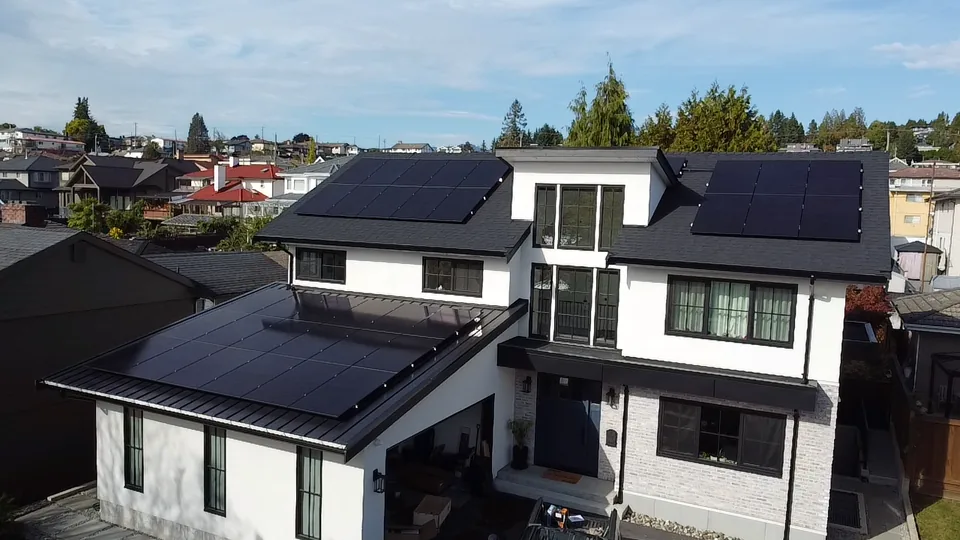
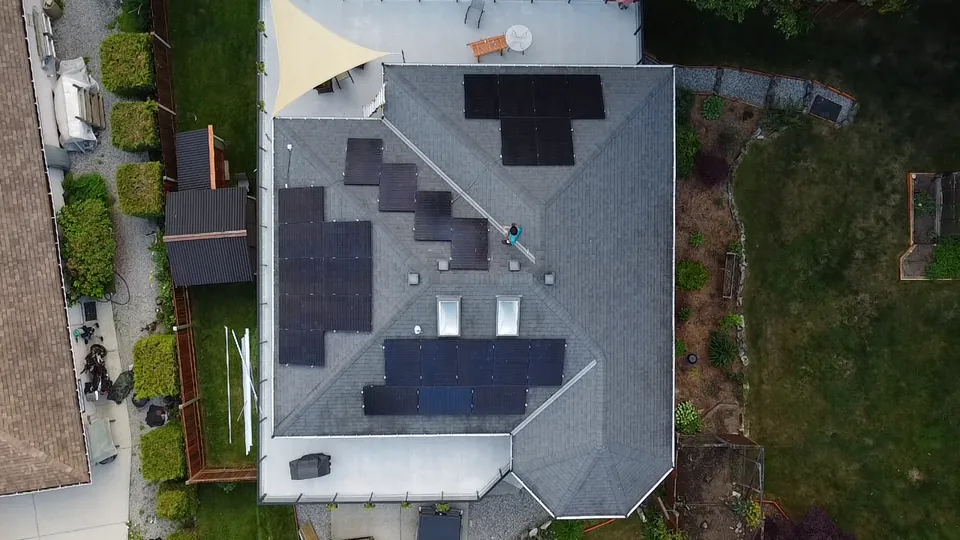
Our Twin Lions project in North Vancouver is a white two storey home with black panels laid across several roof planes. All black panels like these blend into a dark roof, which matters on a house that neighbours look down on from further up the slope.
On a roof like this, broken into planes that each face a different way, a single string inverter would hold every panel back to the weakest one. We put a microinverter under each panel instead, so every roof face produces what its own sun allows.
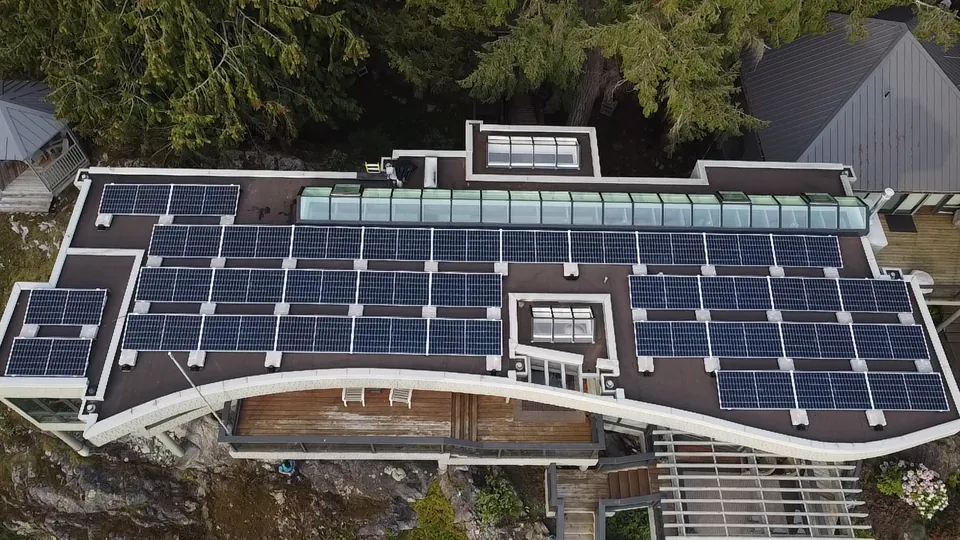
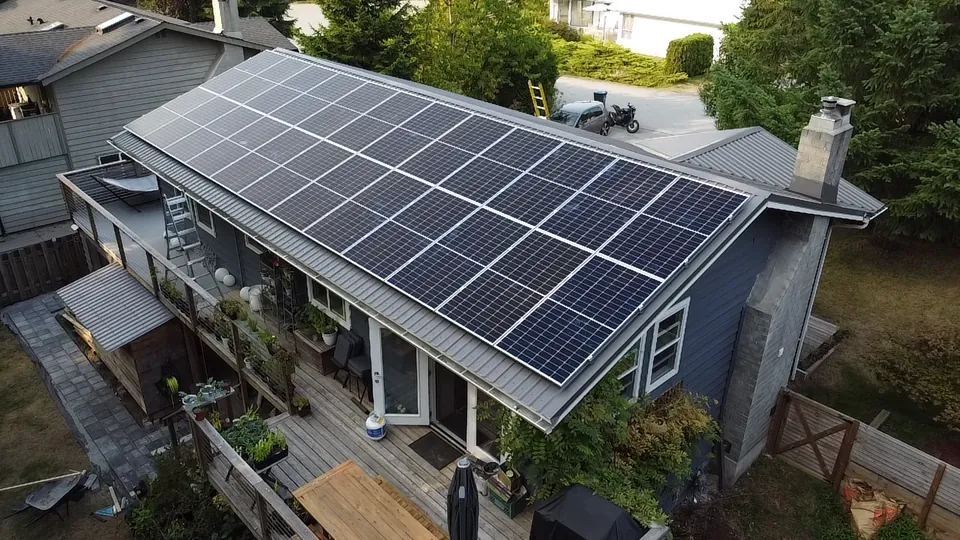
The other photos include nearby installs at Bowen Island and up the Sea to Sky in Squamish, both with the same mix of forest, slope and weather.
North Shore homes range from older houses near Lonsdale to newer builds on the upper slopes, and most of them sit on a slope.
We map where the mountains and trees put shade through the year and place panels where the sun actually lands, which on many North Shore homes means splitting the array across more than one roof face.
Residential solarTrees and power lines share the North Shore, and when a big storm comes through, hillside neighbourhoods can be off for a long time. A hybrid system islands the house and runs it on solar and storage until BC Hydro is back.
Battery storageFlat commercial roofs along the waterfront and the main corridors take ballast racking with no penetrations. Businesses can claim the 30% refundable clean technology investment tax credit.
Commercial solarThe North Vancouver weather station averages about 2,522 mm of precipitation a year, more than twice the 1,189 mm recorded at YVR. That lowers winter output, which is exactly why we size North Shore systems to annual consumption rather than a summer peak. The upside is that the panels rarely need cleaning.
Shade is the biggest single factor in a North Vancouver design. Microinverters let each panel work independently, so a tree shadow that crosses one corner of the array in the afternoon only costs that corner, not the whole system.
The City of North Vancouver and the District of North Vancouver are separate municipalities, and both issue their own electrical permits rather than using Technical Safety BC. We deal with whichever one covers your address.
A December 2025 windstorm knocked out power to more than 120,000 BC Hydro customers across the Lower Mainland, Sunshine Coast, Vancouver Island and the Gulf Islands. On a forested hillside a battery is as much about resilience as it is about the bill.
North Vancouver homes can claim the BC Hydro rebate of $1,000 per kW of solar up to $5,000, and $500 per kWh of battery storage up to $5,000 with Peak Saver enrolment, each capped at 50% of the installed cost.
Because batteries matter more on the North Shore, the battery half of the rebate is often the part that tips the decision. We calculate both halves exactly in your proposal.
Current incentivesWe start with your BC Hydro history and a shade study, then design in 3D so you can see how each roof face performs across the year. Most installs take one to three days. Steep or complex roofs can take longer, and the City or District inspection and BC Hydro connection follow.
Our 5-step approachWhat North Vancouver homeowners ask us before they commit.
Yes, with the right expectations. North Vancouver gets about twice the precipitation of the airport, so winter output is lower, but the long summer days still produce a strong surplus and the rain keeps the panels clean.
It is the main design constraint here. We model shade through the year and use a microinverter on every panel, so partial shade only affects the panels it touches rather than the whole array.
Yes, if the system is a hybrid with a transfer switch. The switch disconnects the house from the grid and your solar and battery run it as its own island until BC Hydro restores power. A standard grid tied system shuts off in an outage.
Both the City of North Vancouver and the District of North Vancouver issue their own electrical permits. We apply to whichever one covers your home and arrange the inspection.
Yes. Hybrid controllers such as the EG4 GridBOSS have AC coupling ports that bring an existing array into a new battery system, and it can also start a backup generator automatically if an outage outlasts the battery.
Rarely. The North Shore rain does most of the work. If a panel does get dirty or covered in debris, only that panel underperforms because each one has its own microinverter, and monitoring flags it before you would notice it on a bill.
We also cover West Vancouver, Bowen Island, Gambier Island and the Sea to Sky up to Squamish, Whistler and Pemberton.
Call 604 817 6527 or send a request. We work across the City and District of North Vancouver.